You've probably sat through the tasting. The braise is perfect. The room smells like a holiday. Everybody nods.
Then the event happens and the line stops moving.
Seasonal and themed food programs are easy to imagine and hard to run. The idea is never the constraint. Holding time is. Throughput is. Whether one tired person can portion it fast without thinking is. If you're buying food service for a large event, the question you actually need answered isn't "what's a good cold-weather menu." It's "which comforting menu still works at my headcount, in my building, with the equipment that fits through my door."
Here's how operators think about that.
What makes a seasonal menu actually scale?
Three things: it holds, it portions fast, and it doesn't need a chef standing over it.
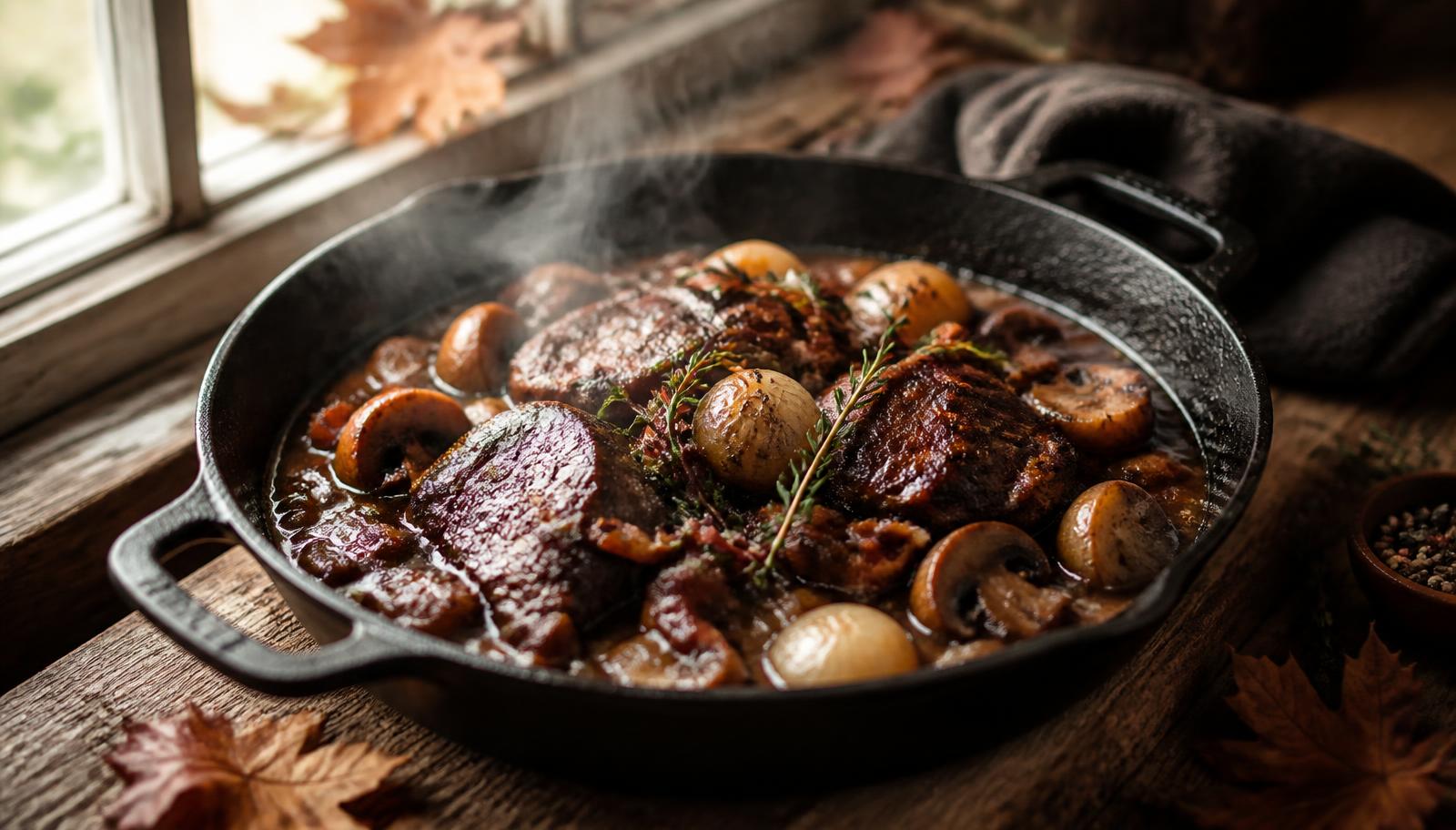
Comfort food happens to be good at all three. That's not an accident of taste. Braises, smoked proteins, stews, baked pastas, and anything cooked low and slow are built to sit in a hotbox and get better, not worse. Compare that to a seared protein cooked to order. One is a volume format. The other is a restaurant format wearing a banquet costume.
So the fastest filter on any seasonal concept is simple. Ask what happens to the dish in the thirtieth minute of service. If the answer is "it's fine," you have a program. If the answer is "you'd want to fire it fresh," you have a tasting menu and a problem.
Which comfort formats hold up when volume spikes?
Generally, four categories do the heavy lifting.
Low-and-slow proteins. Smoked and braised meats are the backbone of Texas-style volume catering for a reason. They're cooked well ahead, they hold, and they portion by weight instead of by plate. BBQ and catering is the lane Artisan Provisions works in, and that lane exists precisely because the format survives scale.
One-vessel hot dishes. Anything that lives in a single pan and gets scooped. Scooping is faster than plating and much harder to do wrong on hour three of a shift.
Handhelds. If guests are standing, walking, or heading back to a seat, the food has to travel. Comforting handhelds solve seasonal warmth and mobility at the same time.
Build-your-own stations. These look like variety and behave like one recipe. You cook a base at volume and let toppings do the theming.
None of the above is a specific menu from either brand. Treat them as category patterns. Actual menus get built against your headcount, your service window, and your building.
How do you theme an event without building a custom menu?
You theme the presentation layer, not the production layer.
The expensive mistake is treating a themed event as a reason to invent new recipes. The efficient version keeps a small number of proven, high-volume bases and changes what sits on top of them. A harvest theme, a holiday-season theme, and a game-day theme can run off overlapping prep with different garnishes, sides, signage, and station names.
Your guests read the room, the smell, the station design, and the naming. They do not audit your prep list. A themed program that feels rich and specific to the guest while running on a handful of scalable bases in the back is the whole trick.
Ask any operator you're considering to show you that separation. If they can't tell you which parts of a themed menu are shared production and which are surface, they haven't run it at size.
What actually breaks first at a large event?
Rarely the food. Usually one of these.
Holding capacity. Not enough hot boxes, not enough power, not enough space near the point of service.
Throughput per station. One station serving too many guests. The fix is station math done before the event, not more staff added during it.
Labor. Seasonal peaks compete with everyone else's seasonal peaks. Staffing a comforting menu is easy in a vacuum and hard during a holiday-season stretch when every operator in the market is short.
Building constraints. Load-in, kitchen access, venue power, waste removal, and where the line physically forms. A menu that works in one building fails in another for reasons that have nothing to do with cooking.
This is where hiring a venue-side operator changes the conversation. Ted E's Kitchen runs concessions and catering inside stadiums, arenas, ballparks, and event centers across DFW, which means the planning starts from the building outward rather than from the recipe inward. Same food, very different set of first questions.
Should you hire a caterer or an operator?
Depends on what you're buying.
A caterer delivers a meal. An operator runs a service. For a seated dinner with a fixed count, the first is often enough. For anything with concurrent stations, concessions, suites, or a crowd arriving in waves, you want the second.
The tell is what they ask you. If the first questions are about menu preferences, you're talking to a caterer. If the first questions are about guest count curves, service windows, power, and load-in, you're talking to an operator. Under JT Hospitality Group, that split is deliberate: Artisan Provisions covers the BBQ and catering side, Ted E's Kitchen covers venue-scale concessions and catering including hospitality suites and private events.
What should you ask before you sign anything?
Bring these to any operator you're evaluating.
- What's the holding window on every hot item, and what does the food look like at the end of it?
- How many guests per station per hour are you planning for, and how did you get that number?
- Which parts of this themed menu share production, and which are surface only?
- Who is on site making decisions during service?
- What happens if my count moves after the final guarantee?
- Have you worked a building like mine, and what went wrong there?
The last one matters most. Anyone who has run seasonal volume has a story about what broke. An operator who says nothing has ever gone sideways is either new or not telling you the truth.
The short version
Comforting food is the easy part. Comforting food that stays good through a long service window, moves a line, and survives a peak-season labor market is a program, and programs get built by people who run them for a living.
If you're scoping a seasonal or themed food program for a large event, send your headcount, venue, and service window to JT Hospitality Group and ask which of its brands fits your event. You'll get a straight answer about whether it's a catering job or a venue operation job.
JT Hospitality Group, the live event brand of Sorrells Enterprises LLC, serving Dallas-Fort Worth and beyond for over 20 years.
Published by JT Hospitality Group